I am a dedicated heirloom farmer, heritage breed caretaker, and homesteader! What does that mean? I realize there is no post on my blog with explanation or discussion.
I can summarize this dedication by sharing a dialogue with a friend today.
The friend said that the doctor recommended she have tomato in her salad every day, for health benefits. It is winter here in the Northeast, and she is still eating tomatoes! Well, I asked her if she knew where the tomatoes in the supermarkets came from? I asked how they could be any good with their coloration and hardness. (Of course, I would never eat one of these myself.) And what of the actual nutrition content - the very reason she was being instructed to consume more tomato? Well, she asked, what about canned tomatoes, are they better? I explained that canned foods represent 25% of the nutritional content of the original crop. One of the motivations in Farmers Frozen Foods -preserving optimum nutritients.
But really, does anyone know what the actual nutritional profile of each crop is these days, since everything is completely altered from its native state? She said she might grow one of those upside down plants this summer. I asked her if she knew where the seed came from? ... and on and on the conversation went.
Anyway, to make a long story short, very few people question their food sources right down to the seed or the breed that becomes their food. I am one of the few!
Genetic Diversity
Each race of native human populations represents a unique gene profile. Studies show that Italian and Finnish people have isolated genetic differences. Heirloom and Heritage is about preserving genetic differences. GMO - genetically modified organisms are our biggest threat due to wind borne cross pollination. We saw how quickly the late blight spread in Northeast tomatoes crops. The same can easily happen with exposing all corn crops to GMO crops.
What percentage of corn and soybeans is GMO?
92% of all soy and 80% of all corn grown in the US was genetically modified
Heirloom seeds
Genetic diversity in our farm fields are as beneficial as diversity in all aspects of life - a better diet results in better health - and pure seed represents the authentic nutrition vitamin, mineral, and amino acid profile. Hybrids are human designs to create a "better" crop - like increased sugar content of sweet corn. Some of these F1 hybrids meet a broader definition of heirloom if they were patented before 1928.
The benefits of saving seed and growing heirlooms has to do with preserving these rare, and in many cases, native crops.
Heritage Breeds
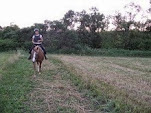
We adopted wild mustangs.
"These horses returned to North America with the arrival of the Spanish explorers and conquerors. These Spanish horses were from the finest strains and were regarded as the best in Europe. They formed the nucleus of the great herds of wild horses that spread upward from Mexico into the United States and the western plains country. Native peoples generally managed their horses somewhat loosely by European standards, allowing the horses considerable freedom. This management style augmented the growing wild herds.
Wild horses were variously called "mustangs," "mestenos," broncos, chapos (meaning short and chunky).
Horses bred to race are designed for speed and endurance - these are hybrids. So too, milk cattle are designed for greater production. Some breeds are naturally better milkers while others have higher butterfat solids. Farmers pick and choose breeds based on natural characteristics or those imparted by human bioengineering. Again, preservation of old world breeds and genetic diversity are the key reasons for raising and caring for heritage breeds.

Homesteading - as traditional crop varieties are being restored to native farmers and gardeners, associated farming traditions are being revived.
We have received favorable press each year in the following venues - each time I published a link to reareseeds.com as our recommended seed source. These include:
Growing Magazine, 2009
http://www.growingmagazine.com/article.php?id=4400Fruit Growers Magazine, 2008
Vegetable Growers Magazine, 2008
Fruit Growers News
http://www.fruitgrowersnews.com
Cornell Small Farms Quarterly, 2007
http://www.smallfarms.cornell.edu/pages/quarterly/archive/fall08/Fall08-11.pdf
SARE Grant Reporting and Proposal, 2005 and 2006
http://www.sare.org/MySARE/ProjectReport.aspx?do=viewRept&pn=FNE06-566&y=2007&t=1
We encourage farmers that grow for Farmers Frozen Foods to purchase seed from heirloom seed sources.


 Homesteading - as traditional crop varieties are being restored to native farmers and gardeners, associated farming traditions are being revived.
 while others compromise, we plant only by giving back each year to enrich the soil with composted horse manure, peat moss (very sparingly & only spot on) and all natural enrichment. This year should be our best ever to celebrate 25 years of growing organically - nope - plastic not included. We simply mulch around our plantings which is a further input to enrich the soil as it quickly composts - hay, grass clippings, etc.